Ex Libris: What It Is, Types of Bookplates, and How They Are Created
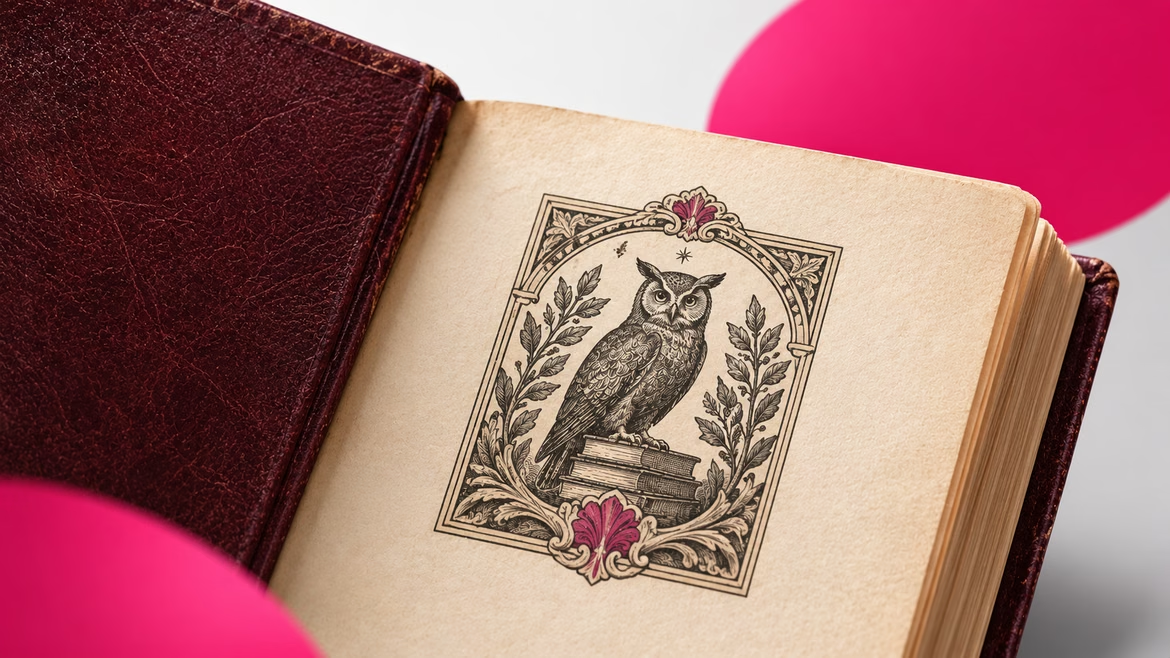

Graphic artist and collector Sergei bought an antique tome from the 19th century at a flea market. On the inside of the cover, he discovered an elegant bookplate with a coat of arms, initials, and a motto in Latin. Sergei became interested: whose coat of arms was this, what did the inscription mean, and how was such a mark created? It turned out that he was looking at an ex libris — not just a sticker with the owner's name, but a true work of graphic art capable of telling the story of a person's fate, interests, and status. Studying this mark turned into a fascinating historical investigation. This story shows that an ex libris is not just an element of a book, but a cultural code that preserves the memory of its owner and era.
What an Ex Libris Is
An ex libris (from the Latin ex libris — "from the books of") is a bookplate that certifies the owner of a book. It is usually pasted or stamped on the inside of the cover, the endpaper, or the spine of the book.
An ex libris may contain the owner's first and last name, their coat of arms, an indication of their profession, and other important details. These marks have existed since ancient times. Some of them are works of art, which increases the value and worth of the book and makes them collectible items.
What is checked in practice: a quality ex libris not only indicates the owner but also reflects their personality, interests, and tastes.
What Is Encoded in It
The first examples of ex libris appeared in the 16th century in Germany as artistic marks of book owners. Since then, the ex libris has become not only a way to designate a publication's belonging to a specific family's library but also an expression of the owner's personality, interests, and tastes.
An ex libris contains many different elements that can tell about the owner of the book.
- First and last name. The most common element of an ex libris, usually written in Latin script in various formats: with a capital or lowercase letter, with or without spaces, and in monogram form.
- Profession or title. Indicates what the owner does or what position they hold in society. The profession may be depicted with a word or a symbol. Old ex libris feature words like "sir," "doctor," "magister," while modern ones have "artist," "writer."
- Coat of arms or emblem. Reflects the owner's belonging to a particular family, their religious or social affiliation, and personal beliefs. The coat of arms often includes many small elements: plant and animal motifs, symbolic objects.
- Various colors. Since an ex libris is usually monochrome, the author chooses a specific ink color according to their preferences: black, violet, green, red.
- Landscapes and architecture. Motifs that can reflect the owner's interests in various places and objects on earth or in their city. Ex libris marks often feature mountains, temples, rivers, plains, and deserts.
What an Ex Libris Looks Like
An ex libris is usually pasted or stamped on the endpaper, the title page, or the spine of the book — an external element of the binding design. These marks are extremely diverse in form, size, and content.
Most often, an ex libris features an image and text. On old examples, this is usually the coat of arms of a family or institution, such as a library, monastery, or university. Coats of arms are often highly detailed; using various graphic techniques, volume and shadows may even be drawn. Many ancient ex libris are true works of art created by renowned artists.
In the marks of the 20th and 21st centuries, the coat of arms is often replaced by a symbolic image meaningful to the owner. Such subjects frequently include books, trees, owls, dogs, cats, portraits, and various buildings.
Almost always, an ex libris also has an inscription indicating to whom the book belongs. It may be placed below the image, above it, around it in a circle or arc, or on ribbons and plaques directly inside the coat of arms or picture.
History of the Ex Libris
The history of the ex libris spans more than five centuries, dating back to the invention and widespread use of printing technology. However, the tradition of decorating books with special marks indicating ownership existed as far back as Ancient Egypt. Until the Renaissance, books were very few, so artists and scribes often drew marks by hand on manuscripts and scrolls.
With the invention of printing in the mid-15th century in Germany and the appearance of the first printed editions (incunabula), the situation changed dramatically. Books became more accessible, and so did ex libris marks, which began to be printed on special matrices and pasted onto bindings.
The first ex libris marks were heraldic, especially widespread in the 16th–18th centuries when heraldry played a major role in public life. Among the famous creators of heraldic ex libris is Albrecht Dürer, who created more than 100 bookplates for various distinguished clients.
Another popular type of book mark during this period was the monogram ex libris, ornamentally elaborated initials of the owner. This type of book mark was especially popular in Poland.
Later, subject ex libris marks appeared. They became one of the most popular types of book marks in the 19th century and represented symbols of the owner's profession, hobbies, views, or fantasies. Among subject ex libris marks, landscape, marine, botanical, zoological, allegorical, and mythological types are distinguished. Some artists began to specialize in creating such marks, for example V. A. Favorsky, G. Narbut, M. M. Schultz.
In the 20th century, ex libris marks became objects of collecting and research. Special societies and journals dedicated to these marks appeared. Ex libris marks often reflect various artistic movements such as Art Nouveau, Art Deco, avant-garde, and abstractionism. They became more diverse in form, color, and technique.
Types of Ex Libris
Depending on the images used, the following main types of ex libris can be distinguished.
- Heraldic. The oldest type of book mark, reproducing the owner's coat of arms. Most characteristic of the 16th–18th centuries, when heraldry played a major role in culture and almost every noble family had its own coat of arms.
- Monogram. Book marks consisting of ornaments with the owner's initials. Besides the first letters of the name and surname, monogram ex libris often contained mottos, slogans in Latin, or quotes from the Bible.
- Subject. The most extensive group of book marks, which may encode the owner's profession, interests, preferences, scientific views, and even favorite animals and family members. Subject ex libris became most popular in the 19th century.
But this is not the only basis for classifying ex libris marks.
By style of execution and the artistic movement that influenced the creators, many types of marks can be distinguished. For example, ex libris in the Renaissance spirit are characterized by proportionality and realistic images, often with antique motifs. Marks in the Baroque style feature an abundance of details, dynamism and splendor of forms, and contrast of light and shadow. The Rococo style makes images elegant and playful, emphasizing natural and romantic motifs and elements referring to secular life. Ex libris in the Classical style are strict, restrained, and symmetrical, with motifs from antiquity.
Later 20th-century ex libris marks in the Symbolist style strive to convey ideas, feelings, and moods through metaphors and allegories, often containing elements of mysticism and fantasy. Ex libris marks in the Art Nouveau style are original, decorative, and curved, with motifs of nature, female beauty, and abstraction.
By color solution, ex libris marks can be monochrome or polychrome. The latter are quite rare, as they are technologically difficult to produce. Monochrome ex libris marks are usually printed in one color, most often black, on a white or colored background. Polychrome ex libris marks are executed in several colors, which may be contrasting or harmonious in relation to each other.
Methods and Techniques for Creating Ex Libris
To a large extent, it is the production method that influences how these marks look.
- Hand drawing — the oldest and most labor-intensive method of creating images on paper using pencil, ink, and other materials.
- Woodcut — one of the oldest methods of creating printed images, which involves carving a picture on a wooden or metal plate with a chisel. Then ink is applied to the carved plate, and an impression is made on paper or another material.
- Linocut — a method similar to woodcut, but instead of wood or metal, a special (non-household) linoleum is used. It is lighter and softer than wood and metal, making this method well-suited for beginner artists.
- Zincography — a printing technique from a zinc plate. It is coated with a special substance that protects the metal from acid, except in areas where the image will be. Then the acid dissolves the unprotected areas of the metal, forming a relief image.
- Lithography — a technique in which the picture is applied to a flat stone or metal plate using greasy ink or oil. Then the plate is coated with a water-repellent substance that is attracted to the greasy areas but repels water.
- Etching — a method in which the image is applied to a metal plate with a needle or another sharp tool. Then the plate is coated with acid, which dissolves the metal in the places where the tool was used.
- Glass engraving — a rare method similar to woodcut, but with the difference that a glass plate serves as the base, and the picture is applied with diamond cutters. Glass does not corrode, so the impression is more accurate.
- Computer graphics — the simplest modern method of creating images using computer programs. With its help, highly detailed images can be developed and easily modified and adjusted on a layout.
Each of these methods has its advantages and disadvantages. The choice of a specific technique depends on the artist's preferences, budget, and desired result.
What is checked in practice: the technique of execution affects the durability and artistic value of the ex libris. Collectors often prefer impressions with clear detail.
Why Collectors Collect Ex Libris
Many collectors hunt for individual specimens, paying large sums for some marks.
- Historical value. Ex libris marks are often associated with famous people (artists, writers, scientists), their lives and achievements. Collectors value the historical significance of such items and strive to preserve heritage.
- Artistic value. Many ex libris marks are true works of art created by talented artists. To create some marks, artists invested enormous effort.
- Uniqueness and rarity. Individual ex libris marks exist in only a few copies worldwide. Due to their antiquity or special fate, only a couple of books with such marks may remain in the world.
- Respect for books, their authors, and love of reading. Collectors passionate about reading may collect ex libris marks to express their love of literature and create their personal library.
- Investment value. Some view ex libris marks as a form of investment. They seek rare or valuable marks to sell them at a profit in the future.
Frequently Asked Questions
What is an ex libris?
It is a bookplate that certifies the owner of a book. It is usually pasted or stamped on the inside of the cover, endpaper, or spine. An ex libris may contain the owner's name, coat of arms, or profession.
What types of ex libris are there?
The main types are heraldic (reproducing the owner's coat of arms), monogram (consisting of ornaments with initials), and subject (reflecting the owner's profession, interests, or hobbies). Ex libris marks are also classified by style of execution and printing technique.
How are ex libris marks created?
There are several techniques: hand drawing, woodcut, linocut, zincography, lithography, etching, glass engraving, and computer graphics. The choice of technique depends on the artist's preferences and the desired result.
Why are ex libris marks collected?
Collectors value ex libris marks for their historical and artistic value, uniqueness, and rarity, as well as a form of investment. Many collect them out of love for books and reading.
In Short
An ex libris is a bookplate that certifies the owner of a book. It contains the name, coat of arms, profession, or other information about the owner. Ex libris marks have existed since ancient times and are collectible items.
The main types of ex libris are heraldic, monogram, and subject. They are created using various techniques, from hand drawing and woodcut to computer graphics. Collectors value ex libris marks for their historical and artistic value, uniqueness, and investment potential.
 What Is Usability: Principles, Evaluation Methods, and Common Mistakes
 Color Palette: What It Is, Why It Matters, and How to Choose Colors for design
 Leading: What It Is, Why It Matters, and How to Calculate It